
For most owners, "selling the company" means one thing: a full exit, receipt of the proceeds, and a handover to the new owner. But for a growing share of mid-market transactions — in Europe and increasingly in our region — the sale is not the end of the story, but the beginning of a second one. The owner sells a majority stake, typically 60–80%, to a financial sponsor, reinvests the remainder alongside them, and together they build something larger through acquisitions: a platform.
This structure goes by several names — majority recapitalisation, partial exit, "buy-and-build" — but the logic is always the same: take substantial value off the table today, keep a meaningful ownership stake in a better-capitalised company, and sell again in four to seven years, ideally at a higher value and a higher multiple. In practice, then, the first sale of a stake already sketches the mechanism of the second, final one. Done well, the strategy makes the second sale worth even more than the first.
How the structure works
In a typical majority recapitalisation, a private equity fund acting as the "financial sponsor" acquires 60–80% of the company. The owner receives cash for the stake sold — the first liquidity event, often the largest financial event of their life — and rolls the remaining 20–40% into the new ownership structure, usually while continuing to run the company as CEO or in a defined leadership role.
From that point, the company becomes a platform: the base from which the sponsor and management jointly execute further acquisitions — smaller companies in the same or an adjacent segment, integrated into the platform to build scale, expand geographically, or broaden the range of products or services on offer. The sponsor brings acquisition capital, the balance-sheet capacity to raise debt financing, and transaction experience; the owner brings the operating company, sector knowledge, and — critically — credibility with the founders of target companies, who are often people much like the owner was a few years earlier.
The arithmetic that makes it work
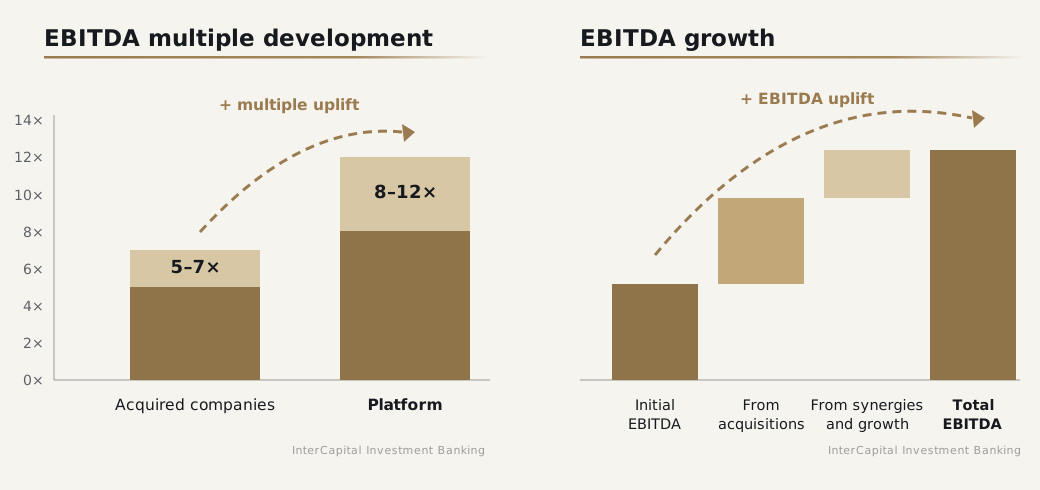
The platform model rests on a piece of valuation arithmetic worth understanding before entering any negotiation: multiple arbitrage. Small companies trade at structurally lower EV/EBITDA multiples than larger ones — a reflection of concentration risk, key-person dependence, and a narrow buyer universe. A business with €1–2 million of EBITDA might change hands at, say, 5–7× EBITDA; a well-run group with more than €10 million of EBITDA in the same sector can command 8–12× or more, and attracts a fundamentally different class of buyer, including international strategic acquirers and larger funds. The underlying reason lies in the fact that a smaller company is riskier, has a less well-organised operating system, is less embedded in the value chain, absorbs industry shocks less easily, and is geographically less diversified than larger groups. As a result, an investor can offer a higher multiple for larger groups of mature companies, since the estimate of future results is usually more reliable and those results are also more stable.
This means that every euro of EBITDA bought at a small-company multiple is, on a successful integration, revalued at the platform's multiple on exit. A platform that buys €1 million of EBITDA at 6× and exits at 10× has — before any operational improvement at all — created significant value through consolidation alone. Add to this realised synergies (for example in procurement, cross-selling, savings in shared support functions, development, and so on) and organic growth, and the base itself — that is, EBITDA — begins to grow. This is also the reason sponsors are often willing to pay more for platforms — and why, for the original owner, the value of the retained 20–40% can over time outgrow the original 100%.
A caution: the arithmetic works if the integration of the original company with the new companies added to the group works. A platform that buys badly accumulates complexity, not value. The exit multiple is attainable, but it must be earned by building a genuinely integrated whole.
What sponsors look for in a platform
Not every good company is a good platform. Sponsors building a "buy-and-build" thesis look for a specific profile:
- a fragmented market with many small players and no dominant consolidator, meaning there is an opportunity for one to be established;
- a company with scalable operations — with well-established operating systems, reporting systems, and management/supervisory staff able to absorb acquired companies into the structure and integrate them, rather than letting the acquisition of a new company disrupt the operations of the existing one;
- a leader willing to stay, motivated and ambitious to grow into the next phase, because a platform without committed management is merely a portfolio — a list of holdings;
- there must also be a visible pipeline of target companies, ideally ones whose founders the owner knows personally, or where indications already exist that they would want to combine.
Several sectors in Slovenia and Southeast Europe fit this profile well: from industrial niches, business services, healthcare services, software and IT services, to specialised distribution, and so on. Markets where the succession wave is simultaneously bringing many quality small companies up for sale, and where the consolidation logic is regional, not merely national. A platform headquartered in Slovenia can credibly consolidate across the Adriatic region and beyond; for the right company, this is precisely the story that attracts international financial investors.
What to negotiate — beyond the price
Owners entering these structures understandably focus on the valuation. In our experience, however, the terms that determine how the next five years will actually unfold — and how much the second bite is ultimately worth — lie elsewhere.
Reinvestment terms ("rollover"). On what terms is the retained stake embedded in the new structure? The owner should, wherever possible, retain the same class of rights as the sponsor; structures where the sponsor holds preferred instruments with liquidation preferences ahead of management's/the founder's ordinary stake can dramatically change the outcome on exit. This point deserves more negotiating attention than it usually receives.
Governance. A 25% shareholder is a minority shareholder. What matters is the list of reserved matters: which decisions — further acquisitions, additional borrowing, management changes, exit timing — require the owner's consent. The goal is not control, which the sponsor has bought, but protection against the narrow set of decisions that could impair the retained stake.
Funding of add-ons. Who funds the acquisitions, and what happens to the owner's percentage if additional capital is needed? Add-ons funded by debt and add-ons funded by the sponsor's additional capital have very different dilution consequences. The owner should understand, before signing, how their stake develops under realistic acquisition scenarios — not just the base case.
Alignment on the exit. When, to whom, and by what mechanics will the platform be sold? Drag-along provisions (the right to pull others into a sale) and tag-along provisions (the right to sell alongside), the treatment of the management stake on exit, and provisions for an early departure (what happens to the reinvested stake if the owner leaves early, voluntarily or otherwise) belong in the negotiation at the start, since from a minority position they can no longer be easily reopened later.
These are precisely the areas where the negotiating asymmetry between sponsor and owner is greatest: the sponsor has done this dozens of times; the owner does it, as a rule, once.
Does this apply to you?
The platform route suits a specific type of owner: one who wants significant liquidity now but has not finished their career. Who has the energy for a five- to seven-year build, is comfortable working with a professional supervisory body and a demanding shareholder, and sees the consolidation opportunity in their market clearly enough to want a financially strong partner rather than watch a competitor seize that consolidation opportunity. It is a poor fit for an owner who is genuinely finished — for whom a full sale process remains the cleaner answer — or for one who cannot accept that majority control, and with it the final say, is genuinely in the hands of a third party.
The good news is that this need not be decided blind. A well-run sale process can be designed to surface both types of outcome in parallel — full-exit offers from strategic buyers and platform proposals from sponsors — allowing the owner, with concrete numbers attached to each option, to compare a clean 100% sale against a sale of a majority stake that at the same time brings the capacity to fund a new growth strategy. That comparison, more than any article, answers the question.
If you are weighing a partial sale, have been approached by a fund, or see a consolidation opportunity in your sector, we offer a confidential, no-obligation conversation — including an honest assessment of whether your company is platform material, and what a sponsor would likely pay for it.

Tim Lep, MSc
InterCapital's Investment Banking Partner for Slovenia and founder of Lep Elevate Partners. He has advised on 17 transactions worth over €500 million, including landmark Slovenian deals. Full biography →